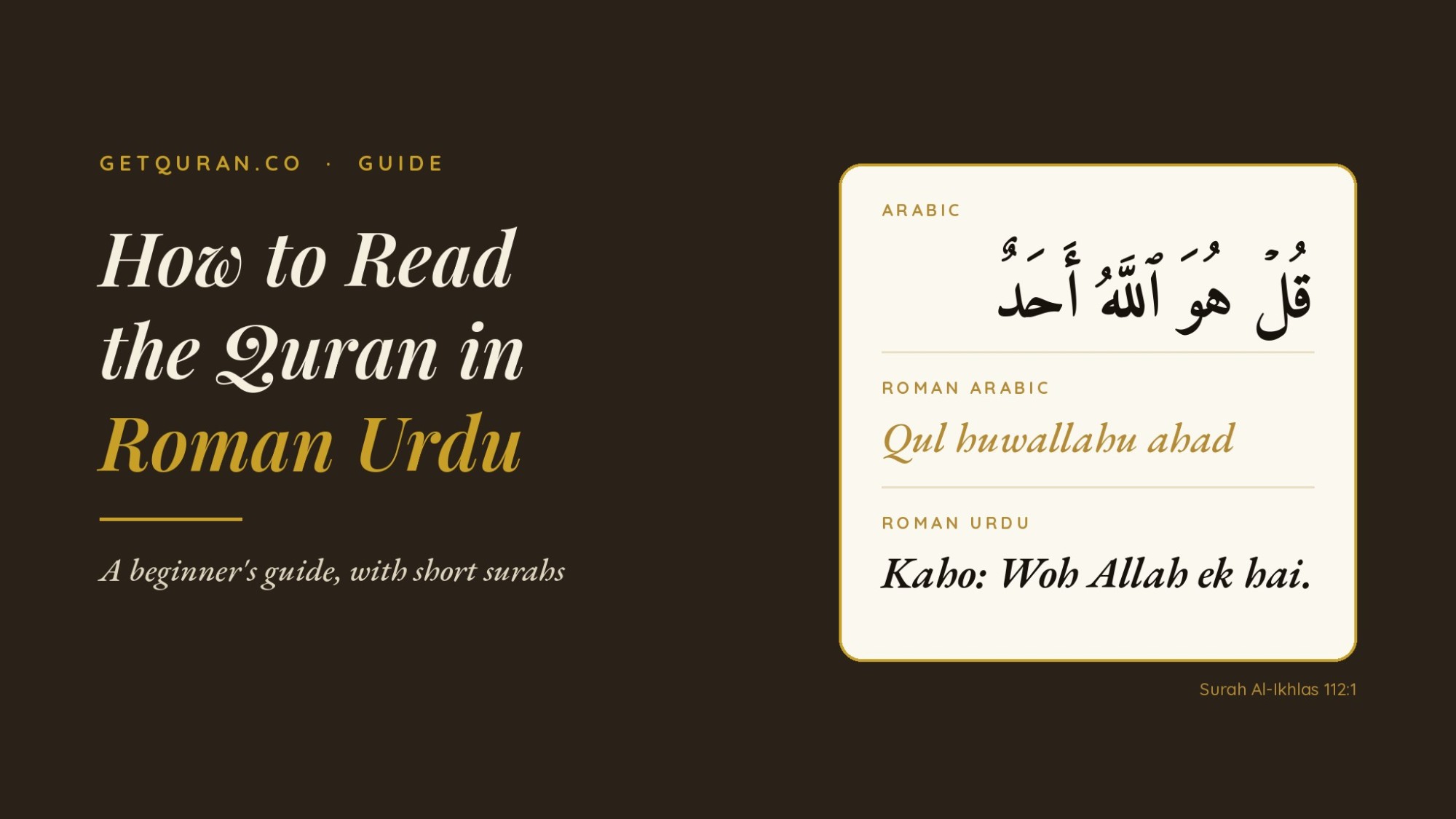
How to Read the Quran in Roman Urdu: A Beginner's Guide
Search for “Quran in Roman Urdu” and most of what comes up is a scanned PDF, a printed copy for sale, or an app listing. Very little of it explains how to actually read one, or what you should expect to find on the page.
That’s worth fixing, because the people searching for it are usually in the same position. You understand Urdu well. You grew up hearing it, you speak it at home, you text in it every day. But you learned to read and write in English letters, so Nastaliq script is hard going, and Arabic script even more so. A Roman Urdu Quran is how a lot of people in that position read the meaning of the Quran for the first time. You can read the full Quran in Roman Urdu on our site; this guide explains how to get the most out of it.
What a Roman Urdu Quran is
Roman Urdu is Urdu written in the Latin alphabet. Allah ke naam se instead of اللہ کے نام سے. Same language, different letters.
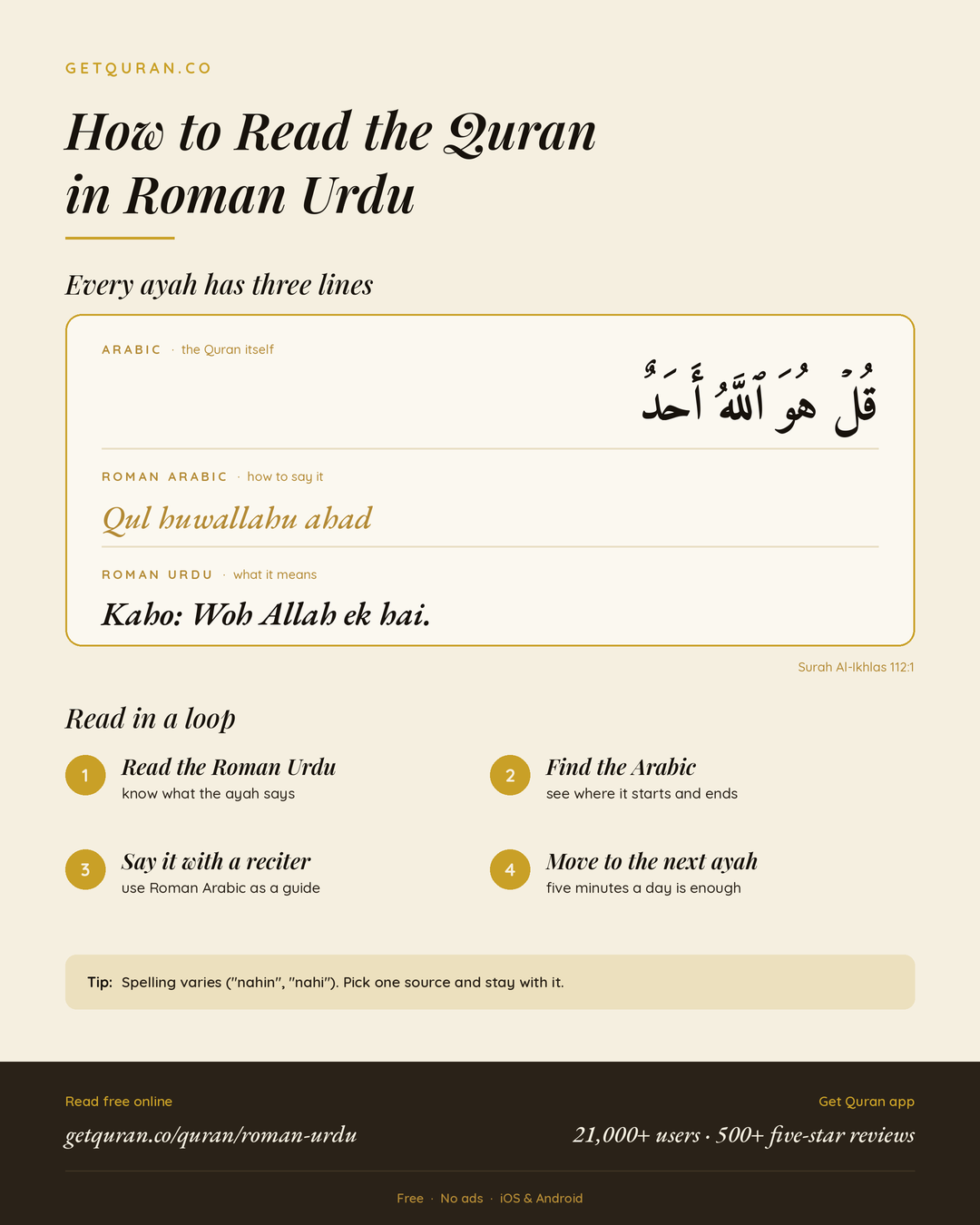
A Roman Urdu Quran usually puts three things together for every ayah:
- The Arabic text. This is the Quran itself.
- Roman Arabic. The Arabic sounds written in English letters, to help you pronounce it while you learn.
- The Roman Urdu meaning. A translation of what the ayah says, in Urdu, written in English letters.
The third line is the one most people come for. The first line is the one that matters most. If you’re wondering whether reading this way is allowed, we went through what scholars say in Can You Read the Quran in Roman Urdu? The short version: the Roman Urdu meaning is a translation, and the Arabic should always be there alongside it.
What to look for in a Roman Urdu Quran
Not every Roman Urdu Quran is equally useful. A few things make a real difference.
A named translator. The meaning should come from a recognised Urdu translation, such as Maulana Maududi’s, Muhammad Junagarhi’s or Fateh Muhammad Jalandhari’s, written out in Roman letters. If a source doesn’t say whose translation it is, be careful with it.
The Arabic on the same screen or page. You should be able to see which Arabic words the meaning belongs to. A Roman Urdu text with no Arabic beside it is just a translation floating on its own.
Ayah by ayah, not paragraph by paragraph. Some PDFs run the whole surah together as one block of Roman Urdu. That’s hard to follow and harder to come back to. One ayah at a time, numbered, is much easier.
Search. The PDFs that turn up in search results are usually scanned images. You can’t search them for a word or jump to an ayah. An app or a website can.
How to read it
The easiest way is to read in a loop:
- Read the Roman Urdu first so you know what the ayah is about.
- Look at the Arabic and find where it starts and ends, even if you can’t read it yet.
- Use the Roman Arabic to say it, ideally while listening to a reciter, so your pronunciation comes from a real voice and not just the spelling.
- Move to the next ayah.
Doing that for five minutes a day gets you further than an hour once a week. Start with short surahs. You already know some of them by heart from salah, and reading their meaning for the first time is often the moment the habit takes hold.
One thing to know about spelling
Roman Urdu has no fixed spelling. You’ll see nahin, nahi and nahee for the same word, and hai, hay and he too. One translation writes Rehman, another Rahman. None of these are mistakes. Just pick one source and stick with it, so your eye gets used to its spelling.
Four short surahs to start with
Here are four passages many Muslims already know by sound, with the Arabic and the Roman Urdu meaning. The Roman Urdu below follows Maulana Maududi’s translation.
Surah Al-Fatihah
The opening of the Quran, recited in every rakat of salah.
بِسۡمِ ٱللَّهِ ٱلرَّحۡمَـٰنِ ٱلرَّحِیمِ ٱلۡحَمۡدُ لِلَّهِ رَبِّ ٱلۡعَـٰلَمِینَ ٱلرَّحۡمَـٰنِ ٱلرَّحِیمِ مَـٰلِكِ یَوۡمِ ٱلدِّینِ إِیَّاكَ نَعۡبُدُ وَإِیَّاكَ نَسۡتَعِینُ ٱهۡدِنَا ٱلصِّرَ ٰطَ ٱلۡمُسۡتَقِیمَ صِرَ ٰطَ ٱلَّذِینَ أَنۡعَمۡتَ عَلَیۡهِمۡ غَیۡرِ ٱلۡمَغۡضُوبِ عَلَیۡهِمۡ وَلَا ٱلضَّاۤلِّینَ
Allah ke naam se jo Rehman o Raheem hai. Tareef Allah hi ke liye hai jo tamaam qayinaat ka Rubb hai. Rehman aur Raheem hai. Roz e jaza ka maalik hai. Hum teri hi ibadat karte hain aur tujh hi se madad maangte hain. Humein seedha raasta dikha. Un logon ka raasta jinpar tu nay inam farmaya, jo maatoob nahin huey (na unka jinpar tera gazab hota raha), jo bhatke huey nahin hain.
(Surah Al-Fatihah 1:1-7)
You’ve probably recited this thousands of times. Read the meaning slowly once and notice the shape of it: praise, then a promise to worship only Him, then a request for guidance. Read the full surah in Roman Urdu on our Al-Fatihah page.
Surah Al-Ikhlas
Four ayahs on who Allah is.
قُلۡ هُوَ ٱللَّهُ أَحَدٌ ٱللَّهُ ٱلصَّمَدُ لَمۡ یَلِدۡ وَلَمۡ یُولَدۡ وَلَمۡ یَكُن لَّهُۥ كُفُوًا أَحَدُۢ
Kaho woh Allah hai, Yakta. Allah sab se bay-niyaz hai aur sab us kay mohtaj hain. Na uski koi aulad hai aur na woh kisi ki aulad. Aur koi uska humsar nahin hai.
(Surah Al-Ikhlas 112:1-4)
It’s short enough to memorise in a day, and the meaning is the core of the faith. Read Al-Ikhlas here.
Surah Al-Asr
Three ayahs. Imam al-Shafi’i is reported to have said that if people reflected on this surah alone, it would be enough for them.
وَٱلۡعَصۡرِ إِنَّ ٱلۡإِنسَـٰنَ لَفِی خُسۡرٍ إِلَّا ٱلَّذِینَ ءَامَنُوا۟ وَعَمِلُوا۟ ٱلصَّـٰلِحَـٰتِ وَتَوَاصَوۡا۟ بِٱلۡحَقِّ وَتَوَاصَوۡا۟ بِٱلصَّبۡرِ
Zamane ki qasam. Insan dar haqeeqat badey khasarey (nuksaan) mein hai. Siwaye un logon ke jo iman laye aur neik aamal karte rahe aur ek dusrey ko haqq ki nasihat aur sabr ki talqeen karte rahe.
(Surah Al-Asr 103:1-3)
Time, loss, and the four things that save a person from it. Read Al-Asr here.
Ayatul Kursi
The 255th ayah of Surah Al-Baqarah. Many people recite it before sleeping and after each salah.
ٱللَّهُ لَاۤ إِلَـٰهَ إِلَّا هُوَ ٱلۡحَیُّ ٱلۡقَیُّومُۚ لَا تَأۡخُذُهُۥ سِنَةࣱ وَلَا نَوۡمࣱۚ لَّهُۥ مَا فِی ٱلسَّمَـٰوَ ٰتِ وَمَا فِی ٱلۡأَرۡضِۗ مَن ذَا ٱلَّذِی یَشۡفَعُ عِندَهُۥۤ إِلَّا بِإِذۡنِهِۦۚ یَعۡلَمُ مَا بَیۡنَ أَیۡدِیهِمۡ وَمَا خَلۡفَهُمۡۖ وَلَا یُحِیطُونَ بِشَیۡءࣲ مِّنۡ عِلۡمِهِۦۤ إِلَّا بِمَا شَاۤءَۚ وَسِعَ كُرۡسِیُّهُ ٱلسَّمَـٰوَ ٰتِ وَٱلۡأَرۡضَۖ وَلَا یَءُودُهُۥ حِفۡظُهُمَاۚ وَهُوَ ٱلۡعَلِیُّ ٱلۡعَظِیمُ
Allah woh zinda e javed (hamesha rehne wali) hasti hai, jo tamaam qayinaat ko sambhale huey hai, uske siwa koi khuda nahin hai, woh na sota hai aur na usey oung lagti hai, zameen aur asmaano mein jo kuch hai usi ka hai, kaun hai jo uski janaab mein uski ijazat ke bagair sifarish kar sakey? Jo kuch bandon ke saamne hai usey bhi woh jaanta hai aur jo kuch unsey ojhal hai ussey bhi woh waqif hai, aur uski maloomaat mein se koi cheez unki giraft e idraak mein nahin aa sakti illa yeh ke kisi cheez ka ilm woh khud hi unko dena chahey, uski hukumat asmaano aur zameen par chayi hui hai aur unki nigehbaani uske liye koi thaka dene wala kaam nahin hai, bas wahi ek buzurg o bartar zaat hai.
(Surah Al-Baqarah 2:255)
This is a long ayah in Roman Urdu, and that’s fine. Read it in parts. Each clause says one more thing about Allah: that He’s alive, that He doesn’t sleep, that everything belongs to Him, that He knows what’s in front of us and behind us. You can read it in context in Surah Al-Baqarah.
After the short surahs
Once these feel familiar, there’s a natural next step. Pick one longer surah and read a few ayahs of it every day. Surah Ya-Sin, Surah Al-Mulk and Surah Ar-Rahman are popular starting points. If you’re not sure where to begin, our guide to the best surahs for peace and protection groups them by what you might be going through.
You can read all 114 surahs with Arabic and the Roman Urdu meaning on our Quran in Roman Urdu page.
Watch: reading the Quran in Roman Urdu
A short walkthrough of reading an ayah with the Arabic, Roman Arabic and Roman Urdu meaning together.
If the video doesn’t load, watch it on YouTube.
Two ways to read the Quran in Roman Urdu with us
Everything in this guide works on both. Use whichever fits the moment.
On the web: nothing to install
Our Quran in Roman Urdu reader runs in any browser, on your phone or your laptop.
- All 114 surahs, each on its own page
- The Arabic, Roman Arabic and Roman Urdu meaning for every ayah
- Previous and next surah links, so you can keep reading
- Free, no ads, no account
It’s the quickest way to look up one surah, or to share a link with someone in your family. Try Surah Al-Fatihah in Roman Urdu to see how it looks. If you’d rather read in English, the English Quran reader has all 114 surahs too.
On your phone: the Get Quran app
If you want to read every day, the app is easier to come back to. More than 21,000 people use it, and it has over 500 five-star reviews on Google Play and the App Store.
- The full Quran. All 114 surahs in the Arabic text.
- Roman Urdu meaning and Roman Arabic for every ayah, the same as the web version.
- 45+ translations, including English, Hindi, Bengali, Urdu, Turkish and Indonesian, so the whole family can use one app.
- Continue reading. It remembers where you stopped.
- Prayer times for your location, a Qibla compass, and Adhan alerts at each prayer.
- Daily duas for morning, evening, travel and sleep.
- Free, with no ads, no in-app purchases and no sign-up.
Download it free on the App Store or Google Play, or see everything it does on the app page.
If you’re curious why we built both around Roman Urdu in the first place, we explained that in Why Roman Urdu Makes the Quran Accessible.
Get the App · Free on iOS & Android
Full Quran in 45+ languages. Roman Urdu. Prayer times. Qibla. Zero ads. Forever free.